Your Scan Says One Thing. Your Body Says Another.

Why an MRI or X-ray doesn't always tell the full story about your pain, injury or what your body is capable of.
You've been struggling with back pain for a few weeks. Perhaps it's your knee that's been giving you grief or maybe your shoulder hasn't felt quite right for months.

Eventually, you manage to get yourself booked in for a scan.
Finally! Some answers.
Then the results arrive.
Degenerative changes. Disc bulge. Cartilage wear. Tendinopathy. Meniscal tear.
Blimey. You only went in with a sore back and now it sounds like your body's falling apart!
But here's the thing...
Just because something shows up on a scan doesn't necessarily mean it's responsible for your pain.
And perhaps more importantly, it doesn't automatically mean you're damaged, fragile or destined to live with pain forever.
Let's explore why.
What Are We Actually Looking At?
First things first, imaging can be incredibly useful.
X-rays, MRI scans and ultrasound all have an important role in identifying injuries, abnormalities and medical conditions.
But there's an important distinction to make.
A scan shows us what your tissues look like. It doesn't necessarily tell us how well those tissues function, how much they're capable of tolerating or whether a particular finding is causing your symptoms.
It's a snapshot of your anatomy, not a complete assessment of your physical health.
And that distinction matters.
Because our bodies aren't pristine pieces of machinery that remain unchanged throughout our lives.
We move. We exercise. We work. We get older. We accumulate experiences, stresses and adaptations.
Our tissues change along the way.
And many of those changes are perfectly normal.
Here's Where Things Get Interesting...
Research has repeatedly demonstrated that people can have abnormalities identified on imaging without experiencing any pain whatsoever.
One particularly interesting systematic review looked at spinal imaging findings in over 3,000 people who had no symptoms.
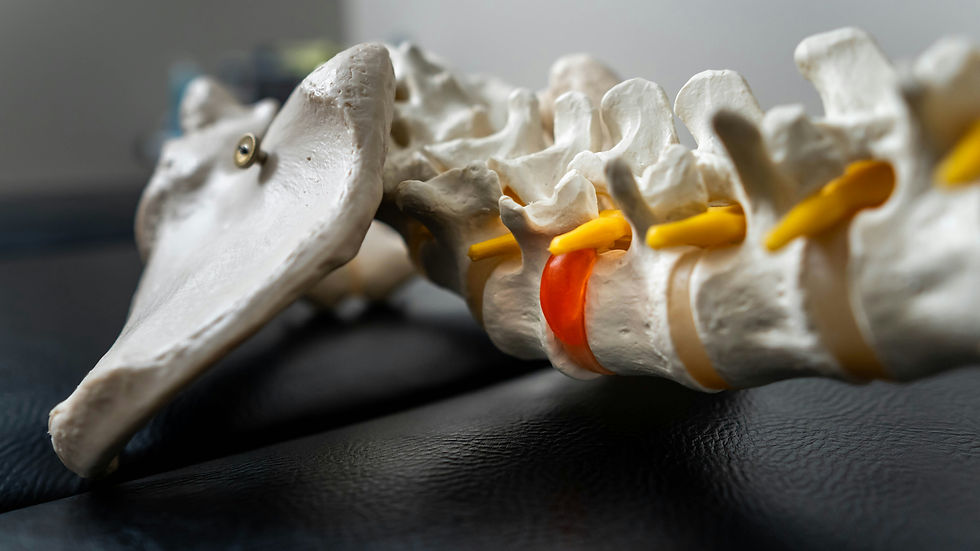
The researchers estimated that:
37% of symptom-free 20-year-olds had signs of disc degeneration.
52% of symptom-free 30-year-olds had signs of disc degeneration.
80% of symptom-free 50-year-olds had signs of disc degeneration.
96% of symptom-free 80-year-olds had signs of disc degeneration.
Remember, these were people WITHOUT symptoms!
And it's not just the spine.
Another systematic review looking at knee MRI scans found evidence of meniscal tears in approximately 19% of symptom-free adults aged 40 and over.
That's nearly one in five people walking around with a finding that might sound pretty alarming if they read it on their own scan report.
Does that mean these findings are always irrelevant?
Absolutely not.
But it does demonstrate why we need to be careful about automatically linking what we see on a scan to what somebody is experiencing.
The Problem With Labels
Imagine being told that you've got a 'degenerative disc'.
Or perhaps you've heard the phrase 'wear and tear'.
Neither sounds particularly reassuring, does it?
In fact, they can create the impression that something is gradually wearing away, breaking down or becoming permanently damaged.
And if you believe your back is crumbling away, how confident are you going to feel bending down to pick up your child?
How comfortable will you be returning to the gym?
Or getting back out onto the golf course?
Probably not very.
The language we use to describe an injury can influence how people understand their bodies and what they believe they're capable of.

That's why context is so important.
A degenerative change isn't automatically a sign that something is failing.
A disc bulge isn't necessarily a ticking time bomb.
And a finding on an MRI doesn't automatically mean you need to stop exercising.
There may be situations where these findings are clinically significant, but we need to establish that rather than simply assume it.
So, If It's Not the Scan, What's Causing My Pain?
This is where things become a little more complicated.
Pain isn't always explained by a single structural finding.
It's influenced by a combination of factors, including tissue health, physical loading, sensitivity, previous experiences, sleep, stress and our general health.
Think about someone who's recently increased their running mileage.
Their knee starts to hurt.
They have an MRI, and it identifies some cartilage changes.
It's tempting to conclude that the cartilage changes must be the problem.
But what if those changes had been there for years?
What if the knee had been perfectly comfortable before the recent increase in training?
Suddenly, the conversation becomes a little different.
Rather than focusing entirely on the cartilage, perhaps we need to consider how much work the knee has recently been asked to do and whether it was adequately prepared for that demand.
The scan finding may still be relevant, but it isn't necessarily the whole story.
And importantly, pain is real regardless of whether a scan identifies a clear explanation.
More Information Doesn't Always Mean a Different Treatment Plan
This is a conversation I have quite regularly with clients at Restore.
Someone has been struggling with an injury for a while and understandably, they want answers.
"Do you think I need a scan?"
And my response is often something along the lines of:
"A scan might give us more information, but would it actually change what we're going to do about it?"
Because that's the really important question.
Let's say you've been experiencing some knee pain. We've assessed your symptoms, looked at your movement, tested your strength and discussed your activity levels.

We have a reasonable idea of what might be contributing to the problem and we've started putting a rehabilitation plan in place.
Now, we could potentially arrange an MRI.
And that MRI might reveal some cartilage changes, tendon abnormalities or other structural findings.
Great. We've got some additional information.
But what happens next?
Well, in many cases, we're still going to be doing exactly what we were planning to do anyway.
We're going to work on settling your symptoms, gradually restoring movement and flexibility where appropriate, building strength and progressively improving the tolerance and capacity of the tissues involved.
We'll manage the demands being placed on your body and gradually increase those demands as you're ready.
We'll work towards getting you back to running, playing golf, lifting weights, playing padel or simply getting through your day without constantly worrying about that troublesome knee.
In other words, we're going to follow the principles of good rehabilitation.
And those principles don't necessarily change because we've now got a fancy picture of the inside of your joint!
Of course, the specific exercises, loading strategies and timescales will depend on the individual and the nature of their problem.
But the broader approach often remains much the same.
The goal isn't simply to identify what's changed structurally. It's to improve what your body is capable of doing.
So when might we actually need that scan?
There are times when additional imaging becomes particularly valuable.
Sometimes the clinical picture isn't adding up.
Perhaps the symptoms aren't behaving as we'd expect. Maybe progress has stalled despite appropriate rehabilitation or we're concerned that something else might be contributing to the problem.
In those circumstances, a scan might help us establish whether we're barking up the wrong tree.
Are we dealing with the issue we initially suspected?
Is there something we've missed?
Could there be a more significant injury or underlying medical condition that requires a different approach?

And, importantly, are there any warning signs that suggest we need further medical investigation?
These are the occasions when imaging can become much more than simply another piece of information.
It can help guide decisions, change treatment, prompt a specialist referral or identify something that shouldn't be managed through routine rehabilitation alone.
If there are concerning symptoms or signs of a potentially serious condition, appropriate medical investigation shouldn't be delayed just to see whether exercises help.
So it's certainly not a case of avoiding scans.
It's a case of using them when the information they provide is likely to make a meaningful difference to the decisions we make.
Treating the Person, Not Just the Picture
This is something I'm particularly passionate about at Restore.
When someone comes into the clinic, I'm interested in far more than simply where it hurts.
I want to understand:
When did the symptoms begin, and what was happening around that time?
What makes things better or worse?
How are you moving?
What strength and physical capacity do you currently have?
What activities are you struggling with?
And perhaps most importantly, what do you want to get back to doing?
Because two people with exactly the same MRI findings can have completely different symptoms, abilities and goals.
One might be struggling to walk comfortably around the supermarket.
The other might be playing 18 holes of golf every weekend without any issues.
Should they both receive exactly the same advice simply because their scans look similar?
Of course not.
This is where a thorough clinical assessment becomes so valuable.
It allows us to put the imaging findings into context and develop a plan that addresses the individual rather than simply the diagnosis written on a report.
Does That Mean Scans Are Pointless?
Not at all.
And I certainly wouldn't want anyone to come away from this article thinking otherwise.
Imaging can be essential when we suspect a significant injury, fracture, serious underlying condition or a problem that requires specialist investigation.
It can also be useful when symptoms aren't progressing as expected or when the findings could meaningfully influence treatment decisions.
For example, NICE guidance advises against routinely offering imaging for uncomplicated lower back pain in non-specialist settings, instead recommending that imaging is considered when it's likely to change management.
In other words, more information isn't automatically better information if it doesn't help us make better decisions.
Sometimes a detailed assessment, a clear explanation and a sensible rehabilitation plan are more valuable than rushing straight towards an MRI.
And sometimes that assessment tells us that further investigation is exactly what's required.
Both are perfectly reasonable outcomes.
What Does This Mean for Your Recovery?
If you've previously had a scan that identified degenerative changes, a disc bulge or another structural abnormality, don't immediately assume that your body is beyond repair.
Equally, don't ignore the findings or assume they're meaningless.
Instead, get them interpreted within the context of your symptoms, medical history and physical assessment.

In many cases, appropriately progressed exercise and rehabilitation can help improve strength, movement confidence, physical tolerance and overall function, even when structural changes remain visible on imaging.
And that's an important point.
You don't necessarily need a perfect-looking scan to have a strong, capable and pain-free body.
Your MRI might look exactly the same six months from now, yet you could be moving better, feeling stronger and enjoying activities that previously caused discomfort.
That's progress.
And it's progress that matters far more to most people than what their scan report happens to say.
The Takeaway
Scans have their place. They're valuable tools, and when used appropriately, they can provide important information.
But they're only one piece of the puzzle.
Sometimes they'll identify something that genuinely changes the direction of your treatment.
Other times, they may simply confirm information that doesn't particularly change what we were planning to do in the first place.
And that's something worth remembering.
Just because we can see more doesn't necessarily mean we need to do more. Or do something different.
Whether you have a scan or not, the foundations of rehabilitation often remain remarkably similar: understand the problem, manage symptoms, restore movement, progressively build strength and develop the capacity to meet the demands of everyday life, exercise and sport.
So next time you hear the words 'wear and tear', 'degeneration' or 'disc bulge', try not to jump straight to the worst-case scenario.
Those words might describe what your tissues look like.
They don't necessarily define what your body is capable of.
At Restore Sports Injury, we focus on understanding the person behind the symptoms, building physical capacity and helping people return to the activities they enjoy with greater strength and confidence.
Because ultimately, we're not here to make your scan look better.
We're here to help YOU feel and function better.


Comments